


Why Are Sika Deer Called the Most Vocal Game Species in New Zealand?
Most deer hunting is a quiet game. The animal comes to you, or it doesn’t. Hunting sika in New Zealand’s North Island is something else entirely, a conversation conducted across dense mountain beech forest and misty valley heads, where the hunter who knows how to speak the language earns their shot. The sika deer (Cervus nippon), introduced to the Kaimanawa ranges in 1905 from a gift of four animals by the Duke of Bedford, has carved out an identity unlike any other exotic deer in New Zealand. It is smaller than a red stag, wilier than a fallow buck, and louder, far louder, than either. To understand why sika have earned their reputation as the most vocal game species on the island, you have to understand what their voice is actually doing.
Why Are Sika Deer So Exceptionally Vocal?
The sika’s vocal range is extraordinary by any measure. Researchers have catalogued more than a dozen distinct calls across the species, ranging from the soft bleat of a calf to the extended, almost operatic whistle of a rutting stag. That whistle, a sustained, high-pitched scream that builds in intensity before cracking into a series of grunts, is the sound that stops North Island hunters mid-stride every April and May. It carries through native forest far better than the low bellow of a red stag, threading between rimu and tōtara trunks to reach ears a kilometer or more away.
The reason sika vocalizations are so elaborate has everything to do with their natural environment. In their native Japanese and East Asian habitats, sika evolved in dense mixed forest where visual contact between individuals is limited and unreliable. Sound, consequently, became the primary medium for social communication. Cows call to locate calves. Calves answer to signal distress. Hinds use soft mewing calls to maintain contact within a group. And stags, during the rut, use their whistling screams to broadcast territory, fitness, and intent, all at once.
In the Kaimanawa and Kaweka ranges, where native forest canopy closes tight and ridgelines fold into one another, those same acoustic demands apply. New Zealand sika deer retained the full vocal toolkit their ancestors developed over millennia, and it has served them exceptionally well in a landscape that rewards sound over sight. For hunters, that toolkit is both the challenge and the opportunity: a well-executed call can bring a wary stag through two hundred meters of second-growth scrub in minutes.
How Does Sika Forest Cover Behavior Differ?
Where red deer in New Zealand tend to use forest edges and open tops for feeding and shelter, sika are fundamentally interior animals. They push deep into native bush, spending the bulk of their time in closed canopy habitat where the understory is thick enough to make visual detection genuinely difficult. This preference is so strong that experienced hunters on the North Island describe tracking sika less like hunting deer and more like hunting pigs, you’re working tight country, reading compressed sign, and keeping your footfalls quiet on ground that rarely opens up.
This forest cover behavior shapes every aspect of exotic deer behavior in the sika’s range. Movement corridors tend to follow creek drainages and ridgeline spurs where the vegetation offers consistent overhead cover. Feeding happens primarily at dusk and dawn at habitat margins, but even then sika rarely commit fully to open ground in the way that larger deer species do. A sika hind that hears or smells something wrong can vanish into regenerating mānuka in three bounds and be effectively invisible within seconds.
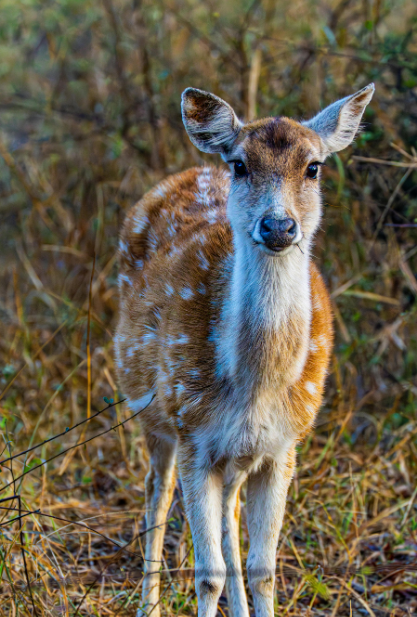
The behavioral contrast also has implications for glassing. Open-country techniques that work for red deer or tahr don’t translate to sika hunting. The productive approach is moving slowly through forest, stopping frequently to listen and call, reading ground sign and working the wind in tight quarters. Hunters who understand sika stag antlers, typically smaller and more tightly beamed than red deer, with distinctive pearling and a characteristic upswept tine, learn to look for brown through green rather than scanning skylines.
What Is the Sika Single-File Movement Strategy?
One of the most distinctive and least discussed aspects of New Zealand sika deer behavior is their tendency to move in single file through dense forest. Where other deer species spread loosely through scrub, sika groups thread along established trails one animal behind the other, often stepping precisely into the footprints of the deer ahead. In soft ground near creek crossings, a well-used sika trail can look like a single deer has passed, until you count the overlapping hoof impressions and realize you’re looking at the combined track of six or eight animals moving with the cohesion of a patrol.
The strategic value is straightforward. Dense native forest presents a constant series of obstacles, fallen logs, supplejack tangles, root systems, and a trail broken by the lead animal costs less energy for every animal that follows. More importantly, single-file movement concentrates the group’s awareness: the lead animal focuses forward while those behind monitor the flanks and rear. Any alarm registered by any individual in the line transmits instantly through body language before a sound is made.
For hunters, this has a practical implication. When you hear sika in the bush and commit to a stalk, the animal you can hear is rarely the only animal present. Moving on a calling stag without accounting for the hinds or satellite males surrounding him is how most sika encounters end in a crashing retreat rather than a clean shot. Patience, triangulation, and a thorough read of the wind direction relative to the whole group, not just the animal making noise, separates successful sika hunters from unsuccessful ones.
How Does Sika Management Protect Native Forests?
The sika deer’s success in the North Island is genuinely impressive, and it creates a genuine conservation tension. Native New Zealand forest evolved without browsing mammals of any kind. The palms, tree ferns, and broadleaf species that define Kaimanawa and Kaweka forest communities have no evolutionary history with deer pressure, and sustained over browsing by sika can suppress regeneration of key native species, particularly tall forest understory plants, across large areas.
Regulated hunting is the most cost-effective and scalable tool available for managing that pressure. Unlike aerial culling programs, which require significant public funding and produce no economic return, a thriving hunting culture around North Island sika generates guide income, accommodation revenue, license fees, and equipment spending, all of which circulate through rural communities that have a direct stake in maintaining huntable populations at ecologically sustainable densities. The hunting community’s advocacy for access, habitat, and balanced management has been a consistent force in keeping sika populations within ranges that native forest can absorb.
The HSCF’s advocacy work reflects this principle on a global scale: hunters who engage with wildlife management policy, fight for hunting access, and support science-based population programs are doing conservation work, whether or not it gets labeled that way. For a deeper look at how these issues play out in real management landscapes, including conversations with New Zealand hunters and wildlife managers, the Hunting Matters Podcast is worth your time.
The sika earned its place in the North Island by being adaptable, intelligent, and loud enough to make itself heard. The hunters and organizations working to manage it well are doing the same.