


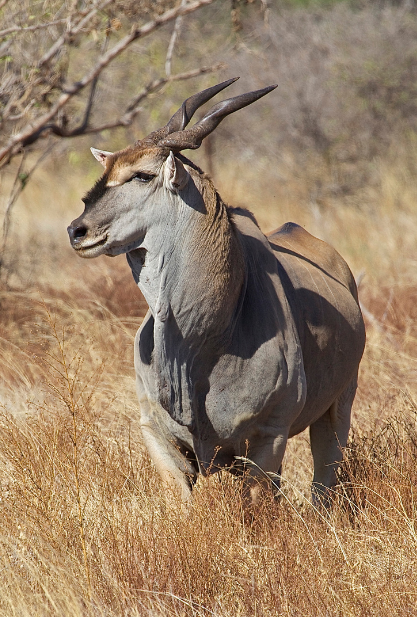
What Makes Cape Eland Herds Unique Among African Plains Antelope?
There is a moment, known to anyone who has spent serious time in the South African bushveld, when the landscape stops looking empty and starts looking full. The grass shifts. A dust line appears where there was none. Then the clicking begins, low and rhythmic, and suddenly there are eland everywhere: a hundred animals moving through acacia scrub with the collective weight and quiet of a slow tide. The Cape eland is the largest antelope on earth, and it somehow manages to be both commanding and easy to overlook until you are standing in the middle of its herd.
What separates eland in Africa from the continent’s other great plains game species is not simply cape eland weight or raw bull eland size, though a mature giant eland bull pushing past 2,000 pounds and standing six feet at the shoulder is a hard thing to be casual about. The deeper difference is behavioral. Eland herds are structured around social systems, communication methods, and survival strategies that have no close parallel among African bovids. Understanding those systems changes the way you read the animal in the field, whether you are hunting, guiding, or simply trying to make sense of what you are watching.
What Causes the Eland Knee-Clicking Sound?
The clicking comes before anything else. Before the dust settles into a silhouette, before the smell of the herd reaches you on the wind, there is the clicking: a steady, woody percussion that carries clean across open ground and through moderately dense bush. Experienced hunters and professional hunters across South Africa describe it as one of the most distinctive sounds in the African field, and new hunters almost always pause the first time they hear it, unsure what they are dealing with.
The mechanics behind the eland clicking sound involve the animal’s feet and lower leg structure. As an eland steps forward, the two halves of its split hoof spread under the animal’s considerable weight and snap back together as the foot lifts free of the ground. Some researchers point additionally to tendon action near the carpal joint contributing to the sound. The precise anatomy is still discussed, but the outcome is not disputed: the click is load-bearing in the most literal sense, and it scales with the animal. A cape eland bull in his prime produces a noticeably louder and more resonant click than a younger animal or a hind, which is one reason experienced trackers use the sound not just to locate a herd but to begin reading its composition before they have visual contact.
Within the herd, the collective clicking functions as passive acoustic communication. Eland groups spread through dense bush where animals lose visual contact with one another regularly, and the ambient sound of the herd moving keeps individuals oriented to the group without any deliberate vocalization. It is an information system built into the ordinary act of walking, and for the cape eland, whose survival depends on herd cohesion across open and broken ground alike, that ambient awareness is genuinely useful.
How Do Eland Communal Nurseries Protect Calves?
A newborn cape eland calf arrives in a world that is immediately hostile to it. Lions, leopard, spotted hyena, and wild dog all take eland calves when the opportunity presents, and a calf that cannot keep pace with a moving group will not last long in serious predator country. The eland’s answer to that pressure is a communal nursery arrangement that is unusual among African antelope of comparable size.
Within days of birth, calves are gathered into creche groups with other calves of similar age. A rotating cohort of adult females attends the creche while the broader herd continues to range and feed. This structure distributes the cost of calf protection: no single female is anchored to a stationary calf for weeks, and the calves themselves are guarded by multiple alert adults at all times rather than relying on one cow’s attention and stamina.
The survival mathematics are straightforward. A predator approaching a creche faces several animals prepared to defend rather than one, and the alarm signals of multiple adults cover a much wider perimeter than a solitary cow could manage. The social benefits extend past the early weeks. Cape eland calves that grow up in creche groups develop the close associations that shape herd cohesion in later life. Young bull eland raised together in nursery groups often maintain loose bachelor affiliations into maturity, which is why hunters glassing open plains will frequently find groups of younger males moving and feeding together, distinct from the older, more solitary cape eland bulls that carry the kind of eland bull size worth pursuing for a serious trophy.
What Are the Eland Arid Foraging Habits?
Most large antelope are specialists. They are committed to particular grass types, particular habitat mosaics, particular water schedules. The Cape eland is none of these things. It is one of the most flexible large herbivores in Africa, and that flexibility is the main reason you find eland in Africa across such an extreme range of environments, from the dry Karoo scrub of the southern Cape to the mopane woodland of Limpopo to the mixed thornveld where Livingstone eland populations have established themselves in eastern and central African reserves.
The eland browses leaves and shoots, digs bulbs and tubers with its hooves, strips seed pods, takes grass opportunistically when it is green and nutritious, and shifts between these food sources based on season and rainfall with very little apparent friction. This dietary range allows the eland to extract moisture from its food and go without standing water for extended periods, a physiological capacity that frees it to use terrain that excludes more water-dependent plains game species.
For hunters and guides working eland on foot, plains game behavior in this species means tracking to the food rather than the water. In the dry season, a mature cape eland bull will be found wherever quality browse is holding moisture, which may be far from any permanent source. Reading the vegetation, understanding what is in season, and anticipating the feeding direction of a methodical, wind-reading animal is the practical application of understanding eland arid foraging habits. The animal covers ground steadily and with purpose. A tracker who understands the feeding pattern can get ahead of it.
How Does Hunting Fund Large-Scale Habitat Reserves?
The Cape eland sits at an interesting intersection in African wildlife management. It is the largest and one of the most physically demanding plains game trophies available to hunters in southern Africa, which means the fees attached to a responsibly managed hunt on a well-run concession are significant. And on the reserves where eland populations are genuinely managed rather than simply tolerated, that revenue is not abstract. It pays for anti-poaching patrols, game fencing, water infrastructure, wildlife reintroduction programs, and the wages of the trackers, rangers, and camp staff who make conservation operations function day to day.
The principle is straightforward even when the politics around it are not: habitat at continental scale requires recurring funding, and regulated hunting generates that funding in landscapes where photographic tourism has no economic footprint and government conservation budgets are structurally inadequate. A single mature giant eland bull harvested on a South African property managed for sustainable yield may directly underwrite months of conservation operations across tens of thousands of acres. That is not incidental to the hunting. It is the point.
This is the argument the HSCF has made consistently across decades of advocacy work, and it is an argument grounded in outcomes rather than sentiment. Hunters who want to engage with how that case is being built and defended across North America and internationally can find that conversation and connection with like-minded individuals through the HSCF monthly events calendar. And for those who want to support the organizational capacity behind that work directly, HSCF membership is where that commitment takes a concrete form.
The eland has outlasted a great deal of change across the African continent by being adaptable and hard to pin down. The conservation model working on its behalf is built the same way.