


How Do Blackbuck Antelope Survive in the Flat Argentine Pampas?
Stand in the middle of the Argentine Pampas and you’ll understand the problem immediately. There is nowhere to hide. The horizon runs in every direction like a taut string, broken only by the occasional windbreak of eucalyptus or the silver flash of a distant estancia’s roof. For the blackbuck antelope (Antilope cervicapra), an animal that evolved on the open subcontinent of India and was introduced to Argentina in the early twentieth century, this exposed landscape should be a death sentence. Instead, the blackbuck hasn’t just survived, it has thrived, building free-ranging populations across the rolling grasslands of Buenos Aires and La Pampa provinces. The secret lies in a set of finely tuned behavioral and physiological adaptations that turn the flatlands from a liability into an advantage.
How Do Blackbuck Avoid Flat-Plains Predators?
The Pampas offers no terrain features to duck behind, so the blackbuck’s first line of defense is pure optics. With eyes positioned wide on the sides of a narrow skull, a blackbuck commands nearly 360 degrees of vision without turning its head. A predator, or a hunter slipping through the gras, that breaks the skyline three hundred yards out has already been spotted. The animal doesn’t wait to confirm the threat. It moves.
Speed is the second line. Blackbuck are among the fastest land animals in the world, capable of sustaining runs above 50 miles per hour over distance. On the flat Pampas, that speed translates directly into survival: there is no ambush terrain for a puma or a domestic dog pack to exploit, so pure velocity decides the outcome. Blackbuck antelope behavior in open country is built around converting warning time into distance, and the Pampas gives them all the warning time they need.
Herd structure reinforces both advantages. Mixed groups keep multiple sets of eyes scanning at all times, and a single alarm snort from any individual triggers a coordinated flight response across the entire herd. Younger males and females typically position themselves toward the center of a moving group, while dominant males on the periphery serve as both sentinels and decoys. For anyone stalking exotics in Argentina, this layered vigilance system is what makes a successful approach so demanding, and so rewarding.
How Does the Blackbuck Male Rut Work?
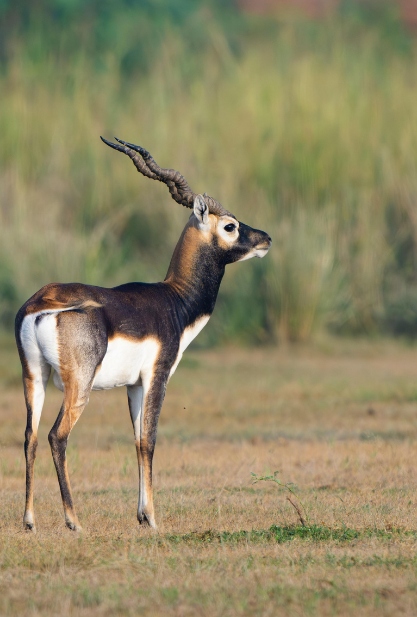
Few wildlife spectacles on the Pampas match a blackbuck rut in full swing. Mature males develop the species’ striking coloration, dark brown to nearly black across the back and face, set against a brilliant white belly and eye rings, and those colors intensify during breeding season as testosterone peaks. The darker and more uniform a male’s coat, the more dominant he is likely to be, and females consistently choose the darkest males available.
Unlike deer species that abandon territories during the rut, blackbuck males defend fixed leks, defined patches of ground that they hold against rivals through a combination of display, scent marking, and direct combat. A buck will circle his lek with an exaggerated high-stepping gait, neck arched, horns swept back, depositing scent from preorbital glands onto grass stems. When a rival male challenges, the response is usually a series of parallel walks and escalating displays before the two close in for horn-to-horn contact.
The spiral horns of a mature blackbuck buck, which can exceed 20 inches in length and make multiple complete twists, are purpose-built for this combat. The tight corkscrew geometry locks with a rival’s horns during pushing matches, preventing the kind of sliding injuries that straight-horned species sometimes sustain. A dominant male may hold his lek and breed with dozens of females in a single season before younger challengers eventually displace him, a natural rotation that keeps the genetic pool diverse and the population vigorous.
Why Do Startled Blackbuck Herds Leap High?
Watch a blackbuck herd break from a standing position and you’ll notice something that seems counterintuitive: several animals will bounce straight up before committing to a run, a behavior called stotting or pronking. Each leap can carry an animal four or five feet off the ground with legs held stiff, expending energy that might otherwise go directly into forward speed. On the surface, this looks like a survival mistake.
The science tells a different story. Stotting is now widely understood to serve multiple functions simultaneously. For the individual animal, the high vantage point of a mid-air jump provides a momentary wide-angle view of the threat, useful for confirming direction and closing speed. For the herd, the synchronized bouncing creates a visual confusion effect, making it difficult for a predator to isolate and track a single target in the chaos of white belly flashes and scissoring legs. And for some predators, the display may signal fitness directly: a blackbuck that can afford to stot is demonstrating that it has the reserves to outrun pursuit, potentially discouraging a chase before it begins.
On the Pampas, where the terrain offers no cover to scatter into, group cohesion during flight increases every individual’s odds. Stotting keeps the herd together and moving in coordinated waves rather than exploding in random directions, a behavioral solution perfectly matched to a landscape without hiding places.
How Does Hunting Protect Grassland Biodiversity?
The blackbuck’s success in Argentina is, in large part, a conservation story built on hunting economics. The estancias that host Argentine blackbuck hunting operations have a direct financial incentive to maintain healthy, expansive grasslands. Overgrazing, monoculture agriculture, and wetland drainage all degrade the Pampas ecosystem, but landowners who generate revenue from wildlife-based tourism and hunting resist that pressure by keeping habitat intact.
This is the same model that the HSCF has supported globally for decades: wildlife pays its own way, and the communities that benefit from its presence become its most committed stewards. In the Argentine context, blackbuck herds occupy marginal grassland that would otherwise face conversion. Their presence supports a suite of native species, burrowing owls, southern lapwings, viscachas, and dozens of grassland bird species, that depend on the same open, lightly grazed habitat.
The HSCF has long recognized that regulated hunting, when structured correctly, generates conservation outcomes that passive protection alone cannot achieve. Funds derived from blackbuck hunting support habitat maintenance, anti-poaching presence, and broader wildlife management programs that benefit far more than a single species. Hunters who participate in these programs, and organizations that support them through grants and memberships, are financing grassland ecosystems in one of the most threatened biomes in South America.
The blackbuck didn’t survive the Pampas by accident. It adapted, and so did the model that protects it.